Toggle Nav
-
Online Wisdom School
Home
Watch/ListenDeeper Learning

Special Lessons
-
 Special Lesson
Life is Bringing You an Opportunity
- Posted: 07/06/26
- 1038 words
- 37 Views
- Comments (0)
There is so much that goes unexplained in human life. And that isn't to say that you and I don't have explanations, but over and over again our explanations prove to be lies. And the way we are able to justify this way of getting around a problem (or a person), and stand momentarily on some ground as if we've conquered the world, is that we believe we have understood the situation and risen above it...
-
Special Lesson
You've Gone As Far As You Can Go With What You Know
- Posted: 06/29/26
- 658 words
- 26 Views
- Comments (0)
Our eyes and ears, thoughts and feelings, empower us to move freely through the extraordinary web of life of which we're a part. But these gifts of perception, as considerable as they may be, are more like a looking glass than they are the keys to that secret kingdom of freedom we seek. With their aid, we can almost see into, and so confirm, that innermost realm where our heart senses we belong.
-
Special Lesson
Bring an End to that Endless Feeling of Being Incomplete
- Posted: 06/22/26
- 1001 words
- 28 Views
- Comments (0)
Whenever we find ourselves running after something -- anything -- to complete us, what is the real nature of this force within us that compels us in this way? We are pushed along in these pursuits by a very subtle, but solid sense of feeling as though we are somehow incomplete.
-
Special Lesson
Try to See Something Before You Try to Be Something
- Posted: 06/15/26
- 816 words
- 27 Views
- Comments (0)
In one respect, at the heart of our predicament as a species of beings -- because it negatively impacts our possibilities -- is that we do not see the big picture. For most of us, the big picture is our problem, our heavy heart, our irritation with somebody else, or our own sense of inadequacy. The big picture is the weight of our past. And that's not the big picture at all. That is a self-pitying picture. It has nothing to do with what it is that we need to understand.
-
Special Lesson
Our Lives Cannot Change Until We Do
- Posted: 06/08/26
- 763 words
- 16 Views
- Comments (0)
If our intuition can perceive that the peace we long for is inherent in this perfectly present moment we call the "Now," what is it that keep us from knowing the fulfillment of its promise within us? Let's look.
-
Special Lesson
For Anyone Willing to Undertake the Interior Journey
- Posted: 06/01/26
- 659 words
- 16 Views
- Comments (0)
Whenever our world changes for the better, it does so for only one reason: somewhere, in some place, someone (just like you and me) is suddenly "changed." Like ripples radiating out from the center of a pond into which a stone has been thrown, the force of the awakened new perception -- this realization of what has always been one's higher possibility -- establishes a new reality. Everything is changed, forever.
-
Special Lesson
Everything is Always in Place, Even When it's Not in Sight
- Posted: 05/25/26
- 1460 words
- 26 Views
- Comments (0)
Can we agree that our fearful conclusions about our life experiences are born of an incomplete perception? That when I see something wholly, there is a different quality to the event than when I look at something and it formulates for me my sense of identity? And then the next thing I know, I feel isolated. And when I'm isolated, strangely enough, I'm still overwhelmed with fear!
-
Special Lesson
Resistance is Part of the Journey
- Posted: 05/18/26
- 1336 words
- 32 Views
- Comments (0)
How many of us have had moments in our lives where we have tried to escape certain qualities of ourselves by doing different things, only to find ourselves unable to escape the condition, unable to escape our present nature, so that finally the day comes where there's no escaping it, but there's no living with it either? And in the moment, we can no longer resist our own character based on the assumption that we ought not be that kind of human being.
-
Special Lesson
Let the Journey Be the Destination
- Posted: 05/12/26
- 747 words
- 20 Views
- Comments (0)
Occasionally, for all of us, we accidentally enter into the flow of the Now. We could be skiing, skating, doing yoga, playing golf, and suddenly our activity aligns us with the flow of that moment. Emotionally we can enter accidentally into the Now when we look out and see the sun breaking through the clouds or we catch the evening light as it shades trees differently. Intellectually we can enter into the Now when we have an insight and an epiphany comes.
-
Special Lesson
The Task of the Individual Who Would Awaken
- Posted: 05/05/26
- 383 words
- 27 Views
- Comments (0)
Life, in the broadest sense of it, both spiritually and materially, is an expression of an eternal descending and ascending set of forces: "In the beginning God created the heavens and the earth" -- the principle of expansion and contraction, light and darkness, ascending and descending archetype ideas then brought into physical creation.
-
Special Lesson
Be Willing to Be Corrected by Life
- Posted: 04/27/26
- 355 words
- 21 Views
- Comments (0)
Just as a ship lost at sea must make a course correction if it hopes to reach a safe harbor, so must the aspirant be willing to be corrected by life for there to be any hope of sighting heaven's shore. And it isn't really so much that life itself corrects us as it is that it serves to reveal us to ourselves. When it does, the choice is ours whether to be self-correcting or deflect the light of revelation that calls for us to change...
-
Special Lesson
The False Life of the False Self
- Posted: 04/20/26
- 519 words
- 23 Views
- Comments (0)
Here's a challenging idea: those who don't know their true identity do not know that they don't know who they are. It's a kind of spiritual amnesia produced by having assumed a false identity without knowing it. How is that possible?










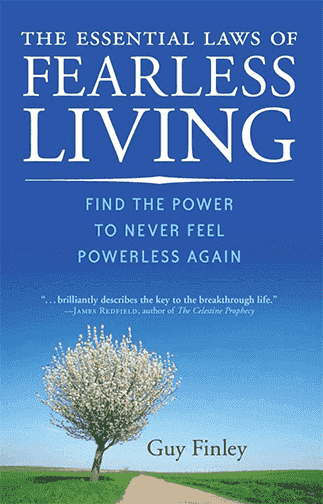
The Essential Laws of Fearless Living
Here is your step-by-step guide to building the foundation of a fearless life. Learn how to see through the illusion of limitation and become unstoppable.