Watchfulness
-
 Special Lesson
Remain Open, Watchful and Honest
- Posted: 03/23/26
- 427 words
- 32 Views
- Comments (0)
Putting our life in God's hands does not mean that we hand Him our wish list for life, but rather that we make His life our wish. When God's will becomes our sole wish in life, then whatever happens to us not only fulfills our wish, but we realize it has always been our wish right from the start.
-
Special Lesson
Would You Like to Live in a Larger World?
- Posted: 12/23/25
- 698 words
- 30 Views
- Comments (0)
Our lives are nothing but a series of invitations, a series of moments in which we run into what we don't know. And in this experience of our own limitations, something good and natural takes place. In its constant stirring and seeking, life feeds back to us the boundaries determined by our present understanding.
-
Special Lesson
Being Watchful is Being Thoughtful
- Posted: 11/04/25
- 1539 words
- 31 Views
- Comments (1)
The two great commandments -- that we should love God with all our heart, soul, mind, and strength, and love our neighbor as ourselves -- are the necessary germinating forces that ultimately give flower to the potential for a human soul to not just reflect what the Divine has made, but to actually participate in the process.
-
Special Lesson
Every Moment Is The Right Moment To See Ourselves As We Are
- Posted: 06/09/25
- 677 words
- 40 Views
- Comments (0)
As we're about to discover, the little phrase, "I see myself," describes a single action that has the power to change the heart of whoever is willing to embrace its practice. But, before we examine the exercise, let's take a closer look at what it means to "see ourselves" -- as we are -- especially when someone else has failed to please us.
-
Special Lesson
Learn What It Means To Watch
- Posted: 02/10/25
- 663 words
- 29 Views
- Comments (0)
We are created to know ourselves not by what we think about, but to know ourselves within God's ever-present, perfectly changing Life. The challenge for us is that we are habituated to thinking about ourselves and deriving a sensation of ourselves based upon the images that we consider.
-
Special Lesson
Enter into the Incorruptible Present Moment
- Posted: 08/08/23
- 1163 words
- 2 Views
- Comments (0)
Most of us hold the unquestioned belief that our hearts and minds are at peace before one of life's "waves" washes in to disturb us. But if we take away the prejudice of self-pleasing images -- and add the ease with which we are disturbed by unwanted moments -- we have good cause to suspect something entirely different about ourselves. Could a truer view of what takes place in such times of...
-
Special Lesson
Let Silent Seeing Free You from Struggling
- Posted: 05/02/23
- 774 words
- 4 Views
- Comments (0)
No moment can be different than it is. We can't change a moment that comes. The moment (and its content) appears from within us, before us, and we are relegated to being able to see it but not to change the very thing that we're looking at as it appears. So that whether we like it or not actually means nothing.
-
Special Lesson
How to Make Way for a New Kind of Will
- Posted: 04/04/23
- 521 words
- 7 Views
- Comments (2)
The next time you run into some familiar blockage or begin to feel unsuited to face some new and difficult personal challenge, don't do what you've always done before. Don't try to think your way around it. You no longer want a way around your troubles because what goes around, comes around! What you want is to grow beyond the level of that disturbance. And to do that, you must not act from it.
-
Multi
Format
Short TalkWhat Should I Do In Unwanted Moments?
- Posted: 03/30/23
- Meeting: 03/05/23
- Time: 00:03:36
- 10 Views
- Comments (0)
"Letting go" author Guy Finley talks about how, most of the time, we don't know what to do in unwanted moments other than resist those moments. Resistance to whatever pains us does not separate us, let alone liberate us from that pain. In truth it binds us to the unconscious nature that creates it. Become the witness to the consciousness instead of the captive of it.
-
Multi
Format
Short TalkWhat Does "Made in the Image of God" Mean?
- Posted: 01/26/23
- Meeting: 12/14/22
- Time: 00:05:24
- 5 Views
- Comments (0)
In this short clip Guy Finley reveals what "made in the image of God" means. When a student asks how to heal from "soul wounds," Guy explains that the soul can't be wounded because it is a microcosm of creation itself and a reflection of all that is made in the image of God.
-
Special Lesson
Catch the Runaway Reactions that Rule Painful Moments
- Posted: 01/26/23
- 592 words
- 3 Views
- Comments (0)
Have you ever heard within you, not necessarily in words, something to the effect of "Oh no, not this again!"? Perhaps we're looking at the latest flame of our heart and we see a fire in his or her eyes, but it's not because they are looking at us. In that moment we no longer see the moment unfold as it is, but rather we stand there transfixed -- experiencing the moment as we are; and we are not really present!
-
Multi
Format
Short TalkSay This Prayer and End Your Struggle With Depression
- Posted: 07/14/22
- Meeting: 06/24/22
- Time: 00:04:02
- 7 Views
- Comments (1)
In this answer to a viewer's question, "Secret of Letting Go" author Guy Finley explains that the authority of negative states such as depression will gradually come to an end when we clearly see and understand the part of us that derives its life from wallowing in the negativity.












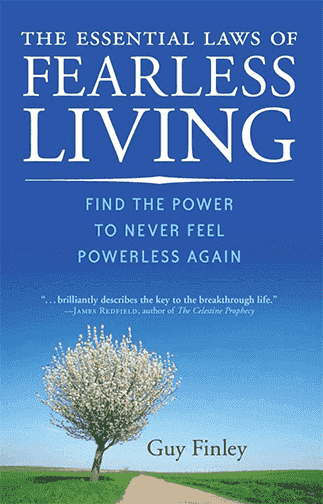
The Essential Laws of Fearless Living
Here is your step-by-step guide to building the foundation of a fearless life. Learn how to see through the illusion of limitation and become unstoppable.