-
 Advanced Inner Life Talk
To Victory I Am Born
- Posted: 03/01/09
- Meeting: 10/29/08
- Time: 00:45:00
- 7 Views
- Comments (0)
Any unkind, cruel thought that we have and hold about the nature of another -- or toward ourselves -- is the dark expression of a slick, sick conflicted level of "self" that's able to hide its chronically negative nature (from itself) by sitting in judgment of others. -
 Inspirational Quote
Guy Finley's Inspirational Quote (4/20/2022)
- Posted: 04/20/22
- Meeting: 04/20/22
- 36 words
- 0 View
- Comments (0)
No one is free who has an ax to grind with any other person, let alone who grind themselves down with painful self-judgment believing, in vain, that self-punishment is somehow connected to self-perfection.
-
Inspirational Quote
Guy Finley's Inspirational Quote #2930
- Posted: 11/04/07
- Meeting: 11/04/07
- 35 words
- 1 Views
- Comments (0)
One reason that judging others so appeals to the self that sits in such judgment of them . . . is because the comfort found in sentencing others for their "defects" serves to convince us of our perfection.
-
 Blog
BlogHealing Begins with Revealing the Concealed (Blog)
- Posted: 11/29/13
- 35 words
- 0 View
- Comments (0)
Judging oneself may seem wise to the level of self involved in that judgment; but all judging of oneself is the deflection of a revelation that would heal oneself... if allowed to flower.
-
Inspirational Quote
Guy Finley's Inspirational Quote #4676
- Posted: 02/26/12
- Meeting: 02/26/12
- 40 words
- 1 Views
- Comments (0)
Negative self-talk requires two things: first, that you lend your ear to some dark part of yourself while it spells out what's wrong with you, and that you then accept its judgment of you by sadly agreeing with its conclusion.
-
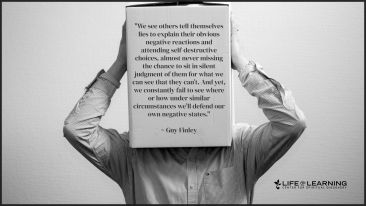 Blog
BlogEnd this Unseen Painful Relationship with Dark States (Blog)
- Posted: 02/28/26
- 55 words
- 5 Views
- Comments (0)
We see others tell themselves lies to explain their obvious negative reactions and attending self-destructive choices, almost never missing the chance to sit in silent judgment of them...
-
Multi
Format
 Advanced Inner Life Talk
Insights You Need to Stop Judging Yourself
- Posted: 05/18/19
- Meeting: 05/15/19
- Time: 00:57:53
- 12 Views
- Comments (0)
Classroom Talk: 5/15/2019 The harsh, or otherwise cruel judgment of yourself feels like it's part of what's necessary to perfect yourself when, in truth, it's actually the mechanical action of an unconscious mind punishing itself for not being as it's imagined it ought to be.
-
Inspirational Quote
Guy Finley's Inspirational Quote #5230
- Posted: 01/12/14
- Meeting: 01/12/14
- 73 words
- 0 View
- Comments (0)
All judging of oneself -- whether of one's own negative characteristics, or that of others -- is the dark effect of a divided mind as it acts against itself. First it gives birth to self-loathing created by an imagined comparison, and then it sits in harsh judgment of both that imagined self and its suffering. In this way it hides its secret involvement in the perpetuation of this false percep...
-
Inspirational Quote
Grow Into a Peaceful Soul
- Posted: 01/11/08
- Meeting: 01/11/08
- 31 words
- 0 View
- Comments (0)
Learning to step back, and to examine your own heart -- before you give someone a piece of your mind -- is the only way to grow peace in your soul.
-
Multi
Format
 Insight Timer Talk
Are You Suffering Over Unseen Self-Love?
- Posted: 03/30/26
- Meeting: 03/28/26
- Time: 00:44:20
- 41 Views
- Comments (0)
Key Lesson: We cannot see what we will not look at... but it is not "us" who refuses to look.
-
Inspirational Quote
Guy Finley's Inspirational Quote #3585
- Posted: 04/01/09
- Meeting: 04/01/09
- 59 words
- 0 View
- Comments (0)
We secretly need those we disdain to be who and what they are – so that in our judgment of them we can "thank our lucky stars" that we're "not like that;" but seen properly, this gratitude is base and mean because it grows out of a self-righteousness that depends upon the existence of those very qualities which we denounce.
-
Inspirational Quote
Guy Finley's Inspirational Quote #424
- Posted: 11/17/02
- Meeting: 11/17/02
- 75 words
- 2 Views
- Comments (0)
If we could only see that any self that sits in judgment over us is not the perfected nature that it passes itself off as being, but is secretly an imperfection in us that only appears true to us due to the unexamined contrast it creates in us by its accusations, then we would at last strip off the mask of our accuser and be free to realize the truth of ourselves without self-destructive conflict.

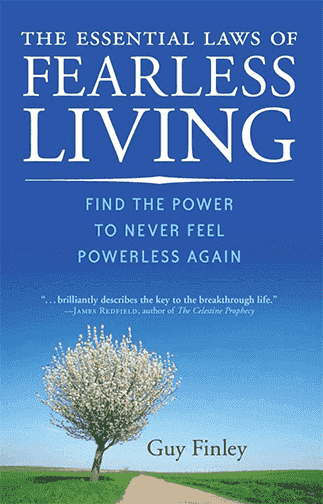
The Essential Laws of Fearless Living
Here is your step-by-step guide to building the foundation of a fearless life. Learn how to see through the illusion of limitation and become unstoppable.