-
Multi
Format
 Short Talk
How Can I Stop Self-Hate?
- Posted: 01/20/25
- Meeting: 12/11/24
- Time: 00:05:31
- 25 Views
- Comments (0)
In this insightful video, we explore the cycle of self-hate and its hidden dynamics. Many of us unknowingly nurture self-hate by identifying with the negativity it generates, creating a perpetual loop of blame and judgment. The key to breaking free lies in awareness—learning to observe and question the patterns driving self-punishment.
-
 Special Lesson
Free Yourself From Useless Suffering
- Posted: 05/04/15
- 206 words
- 1 Views
- Comments (0)
The justification of any negative state serves one end only: the protection and the preservation of the nature responsible for its manifestation.
-
Multi
Format
 Advanced Inner Life Talk
Catch and Drop Useless Self-Talk
- Posted: 05/26/19
- Meeting: 05/22/19
- Time: 01:01:36
- 9 Views
- Comments (1)
Classroom Talk: 5/22/2019 The sure way to guarantee that your suffering goes on unabated is to keep talking to yourself about it!
-
 Short Talk
The Brass Tacks of Dying to Yourself
- Posted: 04/02/14
- Meeting: 03/21/14
- Time: 00:05:00
- 5 Views
- Comments (0)
Real love isn't convenient, and it forces you to see what isn't good in you. The purpose of the work is to strip away all of the intellect's excuses about why you are the way you are. You know you're getting closer to heaven when you have less interest in saving what cannot be redeemed. -
Multi
Format
 Advanced Inner Life Talk
How to Free Yourself from All Forms of Painful Self-Judgment
- Posted: 09/05/22
- Meeting: 09/04/22
- Time: 00:55:33
- 3 Views
- Comments (0)
Classroom Talk: 9/4/2022 - The harsh, or otherwise cruel judgment of ourselves feels like it's part of what's necessary to perfect ourselves... when, in truth, it's actually a mechanical movement of an unconscious mind punishing itself for not being as it's imagined it's supposed to be.
-
 Student Talk
Student Talks on "How to Free Yourself from All Forms of Painful Self-Judgment" (9/9/22)
- Posted: 09/10/22
- Meeting: 09/09/22
- Time: 00:57:51
- 5 Views
- Comments (0)
Student Talks: 9/9/2022 - Key Lesson: The harsh, or otherwise cruel judgment of ourselves feels like it's part of what's necessary to perfect ourselves... when, in truth, it's actually a mechanical movement of an unconscious mind punishing itself for not being as it's imagined it's supposed to be.
-
 Student Q&A with Guy
Student Q&A with Guy on "How to Free Yourself from All Forms of Painful Self-Judgment" (9/4/22)
- Posted: 09/05/22
- Meeting: 09/04/22
- Time: 00:42:06
- 0 View
- Comments (0)
Topics covered: As a rule, human beings know more about their iPhone than they know about the 'i' that is running their lives; It is never useful to judge another person. It is never useful to judge yourself; Nothing ever changes when you judge yourself. And judging yourself is not the same as seeing a true fact about yourself; The more that you judge yourself, the easier it becomes to judge yourself...
-
 Inspirational Quote
Guy Finley's Inspirational Quote #4625
- Posted: 01/01/12
- Meeting: 01/01/12
- 103 words
- 1 Views
- Comments (0)
Negative self-talk -- turning on yourself with a vengeance -- seems to prove the presence of an innocent "you" -- someone (who is) superior to the inferior character you condemn (in yourself). But hating and berating yourself is actually the avoidance of seeing yourself as you are in that moment. All forms of dark dialogue serve an unconscious and divided level of self whose purpose is to c...
-
 Short Talk
Spiritual Poverty is Perfect Possibility
- Posted: 09/09/13
- Meeting: 08/23/13
- Time: 00:05:00
- 2 Views
- Comments (0)
Your responsibility in your spiritual work is to turn over the soil and plant the seeds. The rest has been done for you. -
 Advanced Inner Life Talk
Say No to the 'CIO' (Chief Intimidation Officer)
- Posted: 09/20/14
- Meeting: 09/17/14
- Time: 01:09:00
- 6 Views
- Comments (0)
The more any one of your own thoughts or feelings tries to hurry, or otherwise push you along, the more you should work inwardly to slow down and to meet, directly, that part of yourself that promises you peace 'just ahead'... as long as you agree to endure its pain first. -
 Student Talk
End the Unconscious Suffering Born of Self-Ignorance (Student Talks)
- Posted: 03/09/14
- Meeting: 03/07/14
- Time: 00:57:00
- 5 Views
- Comments (0)
The spiritually blind suffer only themselves, but 'see' others as being responsible for why they feel the pain and sorrow that they do. -
Inspirational Quote
Guy Finley's Inspirational Quote #871
- Posted: 11/28/01
- Meeting: 11/28/01
- 102 words
- 1 Views
- Comments (0)
Part I: The pain we feel over being betrayed is not the fault of the one who has fractured our trust. Such anguish belongs to, and is created by, those darkly combustible parts of us into which we so readily fall and become inflamed whenever certain self-supports are unexpectedly pulled out from beneath us. Part II: Any "I" that hates relates not to the person it holds responsible for this r...

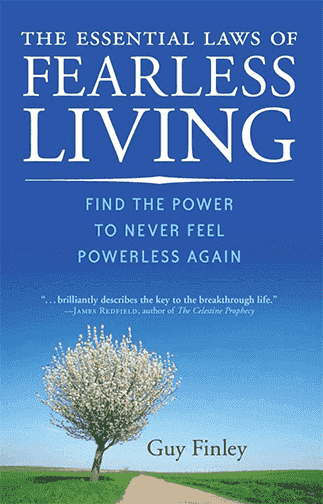
The Essential Laws of Fearless Living
Here is your step-by-step guide to building the foundation of a fearless life. Learn how to see through the illusion of limitation and become unstoppable.