-
Online Wisdom School
Home
Watch/ListenDeeper Learning

Special Lessons
-
 Special Lesson
Walk Past All Negative States
- Posted: 02/24/25
- 1072 words
- 55 Views
- Comments (0)
We value negative states because of the strong sense of self we get from them. This may be very difficult for us to see, but a strong light will show us the freeing facts. No one wants to believe that he or she values things like self-pity, anger, and depression. We would insist we don't, and as evidence we point to the fact that we fight against them, but the struggle gives us a false sense of life and importance...
-
Special Lesson
Stop the Cycle of Useless Thought
- Posted: 02/18/25
- 975 words
- 29 Views
- Comments (0)
Most of us don't understand the nature of time and our place within it, and so we know nothing of timelessness, save for those rare instances when we encounter transcendent beauty and are transported out of our usual train of thought in time, into the timeless.
-
Special Lesson
Learn What It Means To Watch
- Posted: 02/10/25
- 663 words
- 28 Views
- Comments (0)
We are created to know ourselves not by what we think about, but to know ourselves within God's ever-present, perfectly changing Life. The challenge for us is that we are habituated to thinking about ourselves and deriving a sensation of ourselves based upon the images that we consider.
-
Special Lesson
Do What Is In Your Power
- Posted: 02/04/25
- 1457 words
- 30 Views
- Comments (1)
What is it that makes us feel powerless when someone does something and it punishes us, or we hear some unwanted news? Let's examine it. Something happens that I don't like, and what am I looking at in that moment? I'm not looking at the thing that I don't like. What I'm "looking at" is the whole condition of myself that feels challenged, threatened by, overcome through whatever it is that it sees. But what does it see other than something that it resists?
-
Special Lesson
The Only Way to Change
- Posted: 01/27/25
- 1088 words
- 48 Views
- Comments (0)
Why do I ever get frustrated with someone or something? Why am I frustrated with them? Because they're bringing up inside of me what I don't know what to do with, because they are making me aware of a pain that was part of my life before I sat down to have the pie with them -- that's why.
-
Special Lesson
Cross the Border Between Conscience and Unconsciousness
- Posted: 01/20/25
- 1822 words
- 48 Views
- Comments (0)
Where is the border between conscience and unconsciousness? The reason the world is beyond repair is because it is populated by a race of beings that now believe that they are conscious. They are not conscious; you are not conscious. The proof that you are not conscious is that you hurt one another, that's the proof of it. And that you hurt yourself, that's the proof of it. Every time you talk to yourself, every time you punish yourself...
-
Special Lesson
Be the One Who Places Your Attention Where You Want It
- Posted: 01/14/25
- 884 words
- 75 Views
- Comments (0)
Our attention is precious. Our attention may be the most important thing that we own, and almost none of us own any of our own attention. Anybody can take it. A phone call can take it. The news can take it. Look in the mirror and it can be stolen. I'm looking in the mirror and I don't look anything like I'm supposed to look, and if I look in the mirror and I don't see what I like, where does my attention go?
-
Special Lesson
The True Beginning We've Been Searching For
- Posted: 01/05/25
- 304 words
- 32 Views
- Comments (0)
It's crucial for us to understand that the thrust of our habitual thinking lives with its attention fixed, not on beginnings, but on the end of things. Don't we always wonder what our lives will be like tomorrow? Aren't we forever dreaming about how different things will be once we win this or achieve that? Don't we, in our mind's eye, perpetually walk towards a brighter moment to come, thinking about how good we'll feel once we're able to resolve some...
-
Special Lesson
Choose to Change Right Now
- Posted: 12/30/24
- 275 words
- 26 Views
- Comments (0)
The perfectly present moment is both the seed of who you are and of your experience of now. And just as you can't separate who you are from your experience of now, neither can you separate now from the real moment of change. They are the same. You can't end conflict later. You can't stop being sad, or cruel, or angry, or scared, or anxious later. Later does not exist in reality. This self-created, false concept of time allows it to create yet...
-
Special Lesson
Living from a Whole New Order of Self-Understanding
- Posted: 12/22/24
- 298 words
- 35 Views
- Comments (1)
Perhaps you've worked hard to be more aware of yourself in the Now, and that for this effort you catch a glimpse of how quick you are to judge others, to criticize them for their "failings." This pain that strains you -- and those you touch with it -- is itself a creation of a false sense of your own perfection. But your awareness of its punishing presence within you is the same as your invitation to transcend the negative nature that is responsible for it.
-
Special Lesson
Who We Really Are Cannot Be Lost
- Posted: 12/16/24
- 942 words
- 30 Views
- Comments (0)
What is one of the most limiting ideas that our physical senses report to us? The idea of time. "Time! Where's it going? I can't hold onto anything, try as I might: what I won; how you felt; the way she looked; the things I love..." Like the torrent of a strange river that vanishes from view as it rounds an impassable bend in a shadow-filled gorge, what is past just disappears, leaving only memory in its wake, itself subject to the ravaging passage of time.
-
Special Lesson
Real Life is Change Itself
- Posted: 12/09/24
- 632 words
- 29 Views
- Comments (0)
Whenever we find ourselves in some "unwanted" part of ourselves, perhaps reliving an old heartache or caught in the throes of some irrepressible anger, old fear, or unyielding worry, part of this unwanted moment includes our certainty that we're trapped in this condition. And compounding our confusion over feeling ourselves captive in this way are all of the attending negative inner voices.













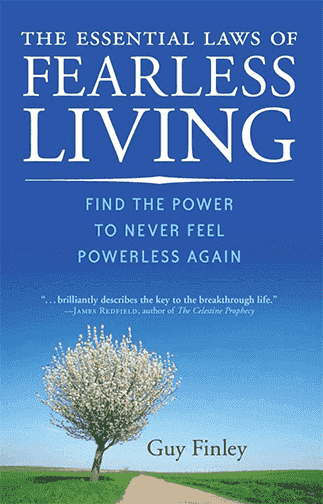
The Essential Laws of Fearless Living
Here is your step-by-step guide to building the foundation of a fearless life. Learn how to see through the illusion of limitation and become unstoppable.