Unconscious desire is the root of corruption. What I desire, what you desire -- whatever it may be -- we can find a way, as surely as the sun will rise, to justify what we want. And because we can justify what we want, it means, at any given point in time, the end will justify the means. "I need this because I was treated like this when I was growing up;" "I need this because I'm not as attractive as someone else;" "I have to have this because I'm getting older;" "I need people to approve of me because I don't feel loved." Fill in the blanks. The desire will create a string of justifications. The justifications will allow me to do whatever I need to do in order to protect myself or pursue what I believe will fulfill me. And in the constant state of justifying what that means is, the end always comes out to be the corruption of the individual in the hands of that desire, because it's fully descending.
Do you see this with me? We mustn't distance ourselves from seeing these things, for how would we even know that there was something dark in us that called itself the light if there wasn't some light to reveal that darkness to itself?
So, what would men and women do if they were reminded momentarily, and then consistently, that there is a quality, a character that exists in them, present at all times, capable of justifying its hunger in such a way that it doesn't seem like an appetite being filled -- rather, what it instructs the individual to do seems like something beneficial for everyone?
One day, either you will have such a hunger and thirst to understand the truth of yourself, or you will remain a human being who does nothing other than practice appearances for the sake of keeping a sense of yourself in place. And may God have mercy on your soul if that's the truth, because how long do you think you're going to be in this body? But that's an inconvenient thought, isn't it?
If one wants to know something of one's character, all one has to do is look at what one values. You cannot separate one's character from one's values. In order to know what one's character is, one has to first recognize and then not lie to oneself about one's values. Because you can't see character, but you can see its expression through values, can't you? Ask yourself what you practice, what you pursue, what it is that you are trying to possess all the time, and then you know what you value.
So what do you value? Not what do you profess, but what are your actions every day? Where is your mind, your heart? What is it vested in? Our intrinsic values, the intrinsic values of humanity in its present state, are basically in three areas: I value the approval of others because, through it, I temporarily gain a sense of my own significance. And because I value approval, I value appearance above all else. But more important than valuing the appearance that others see, I value seeing myself in my own eyes in a certain way. And the way I know that I'm vested in that value is that, through a contrivance, I can explain acts of an unconscious nature. That character hides itself so it always has a justification for why I am the way I am. Because if I were to see how I am without justifying it, then my appearance -- the way I see myself -- would fall apart, wouldn't it?
Character can't be created by us. The things that are timeless, everlasting in value, are intrinsic -- which means in and of themselves, they are good. But our values are about means to the good, not the good itself. It is through the spiritual revelation of our weaknesses, it is in psychological understanding of a spiritual revelation that a person begins to understand where they find the intrinsic good. The intrinsic good rests within the individual, and surprisingly within the very thing the individual has no value for at all.
We are divided into two natures. The first is a nature that wants certain qualities, certain values. We believe that the self that sits and judges -- that loves one and despises the other -- is us. It is not us, because the second nature, who we really are, the real nature, wants to be good -- not because of what we take from it, but because in goodness alone, in what is intrinsically whole, the good of anything is the holiness of it. In our communion with it, we are at peace. We are capable of being an instrument of that life that we value above all else.
What are some of the intrinsic values and their character? Honesty, integrity, kindness, patience, compassion, gratitude, humility, self-sacrifice, forbearance. Imagine if those intrinsic values were mine, if my character was the instrument through which these values lay latent and active at the same time. What could come along that would be a problem to an individual whose character was the expression of these forms of goodness? If you look at it carefully, what you'll see is that your whole life is about pursuing these things after you find yourself without them.
When do I want kindness? After I've been unkind or when I think about how good I'll feel if I'm kind. When do I want patience? I want patience after I've seen I have none. Humility -- which is of no interest to human beings -- is possibly the most valuable quality of character. Not practiced humility where I learn to appear humble, but humility born out of understanding my relationship to creation itself -- my role in it.
So when does a person want those things? When am I interested in compassion? When, for being compassionate, I will feel good about myself, or you will see me as being good. And what's the proof of this? Where is my compassion when I'm in conflict over something? I'm sitting there, irritated to the "nth" degree, and someone walks up to me, and I can see they are in pain. Where's my compassion? Why don't I have it then? That person's character has elicited from me a resistance to them. My value now is to abate or somehow dismiss what I'm resisting -- either through acting as I think will get rid of it, or that I just get rid of the problem altogether by keeping myself away from any situation like it.
Without these intrinsic values there would be no chance for a human being to be reborn. There would be no chance for anything good or true in the world. And what is this struggle that one has in life if not the struggle between a certain order of light and a certain order of darkness? The fact is that within me, apparently there must be some of this intrinsic character, because if the intrinsic character weren't there to reveal where the compromise was occurring, I'd never know I was compromised.
Can you see there's hope in that? Because if that weren't the case, then how would I ever understand that I'm part of a world right now whose sole task is to bury this character? I would not know it, because I'd be too busy. It's just that every once in a while, when I throw a shovel of dirt over the possibility of being a new order of human being, something in me says, "Look at the world that you're making with your shovel!" But then, because the nature that reveals that to you isn't something that is valued more than the sense of self that comes with judging yourself for being that kind of human being, in that split second you forget you've got the shovel in your hand, and you go back to shoveling. And you say, "I hate myself, I hate myself," even as you shovel. Isn't that true? You mustn't lie. Liars are doomed to repetition and recurrence, becoming further crystallized by their resistance to revelation until their soul itself is destroyed.
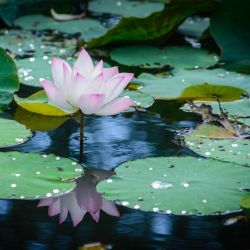
So the question is, from where comes my relationship to the spiritual flowers of love, humility, and compassion? How do I become compassionate when nothing in me has any interest in it at all because I'm so busy trying to protect myself from some pain I'm in? What's the nature, the character of forgiveness, of compassion? Where does one find it? It is always first found in the awareness of something. All of these characters, these values, these qualities, they exist first and foremost in our relationship with them through an awareness.
I want integrity, but I'm two-faced. I'll change my appearance so that I can get along with you to get something I set you up for. Where's the integrity? What's its character? How do I come to it? There is only one way. Right there, in the moment of that lack of integrity, I have to see so clearly that what's going on in me is something saying, "Compromise, compromise, compromise!" And then I taste that, and don't create a value out of it through which I have an incentive to be different tomorrow because of judging myself today. From that only comes the true beauty of hungering after righteousness for righteousness' sake... not as a means to attain something by which I will be different, but because of the clarity of seeing what I am as a result of not having it. And out of all that comes the purity of heart that I can't give myself.
The interior struggle to know that my need for goodness must be my life means that I must sacrifice the only life I know without knowing I'm going to get the good that I want in return... because that's the order of things. First the sacrifice, then the flower of goodness.